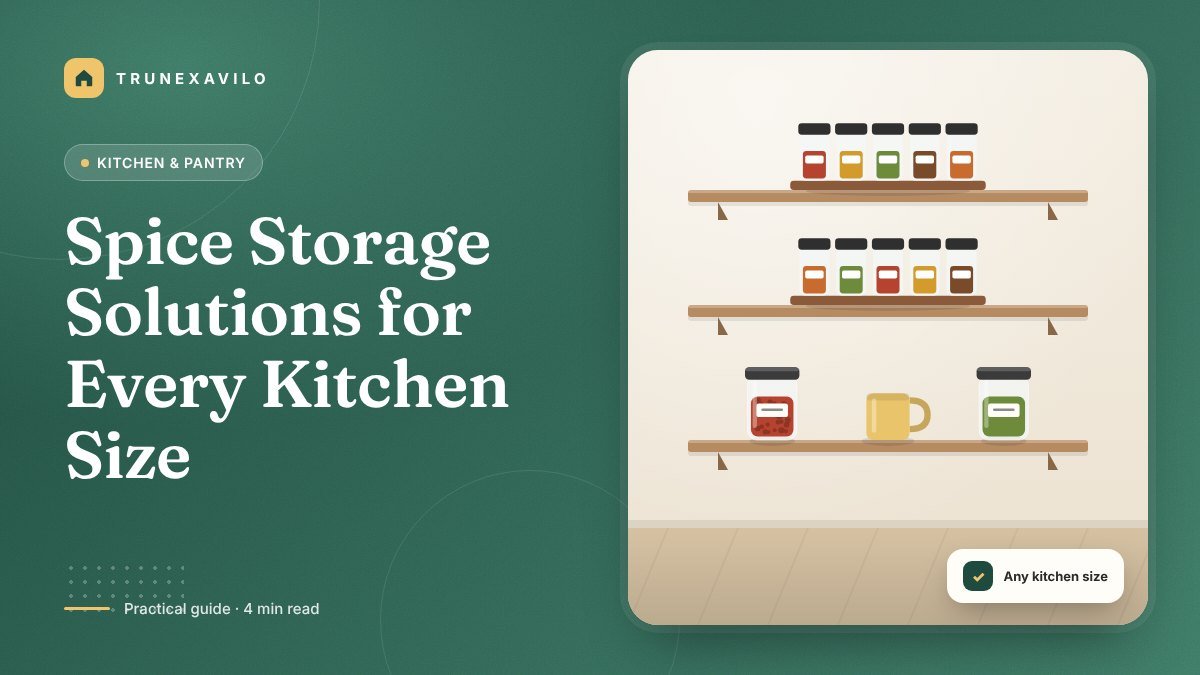
Spice Storage Solutions for Every Kitchen Size
From tiny apartment kitchens to large family spaces, find the right spice storage setup, plus tips on freshness, labeling, and buying spices without overspending.
On this page
- Step 1: Audit Your Collection
- Step 2: Know What Spices Need
- Solutions for Small Kitchens
- Solutions for Medium Kitchens
- Solutions for Large Kitchens and Serious Cooks
- Alphabetize or Group by Cuisine?
- Smart, Budget-Friendly Buying
- Labeling Tips
- Keeping Your System Organized
- Frequently Asked Questions
- The Bottom Line
Spices are small, but they cause a surprising amount of kitchen frustration. You can't find the cumin, you buy a new jar, and then you discover two more behind the oregano. A good spice system solves that problem and saves money at the same time.
The best solution depends on your kitchen's size, how much you cook, and how many spices you keep. Here's how to choose.
Step 1: Audit Your Collection
Gather every spice you own, including the ones hiding in the pantry, the back of a cabinet, and the drawer by the stove. Then:
- Combine duplicates into one container.
- Check freshness. Ground spices lose flavor over time. If a spice has little aroma when you rub a pinch between your fingers, it's probably past its prime.
- Remove spices you never use. That bottle you bought for one recipe five years ago can go.
Most home cooks regularly use somewhere between 15 and 30 spices. Knowing your real number helps you pick the right storage.
Step 2: Know What Spices Need
Spices last longest when kept away from heat, light, moisture, and air. That means the shelf directly above the stove, while convenient, is one of the worst places to store them. Heat and steam degrade flavor quickly.
Choose a spot that's close to your cooking area but not directly exposed to the stove's heat.
Solutions for Small Kitchens
Door-Mounted Racks
Mounting a slim spice rack on the inside of a pantry or cabinet door uses space you're probably not using at all. Measure the door's width and check that shelves won't hit when the door closes.
Tiered Shelf Risers
A three-step riser placed in a cabinet lets you see every label at once instead of reading only the front row. This is one of the cheapest and most effective spice upgrades available.
Magnetic Tins
Small magnetic tins can attach to the side of a refrigerator or to a metal board inside a cabinet door. Keep them out of direct sunlight to protect freshness.
Solutions for Medium Kitchens
In-Drawer Inserts
If you can spare a drawer near the stove, an angled in-drawer insert is a favorite among home cooks. Jars lie at a slant with labels facing up, so you can scan everything in seconds. Add labels to the jar lids if your jars sit upright.
Turntables
Lazy Susans work well in corner cabinets. A two-tier turntable doubles your capacity. The downside is that items in the middle of a crowded turntable can still be hard to see, so they're best for a moderate collection.
Solutions for Large Kitchens and Serious Cooks
Pull-Out Cabinet Organizers
Narrow pull-out organizers fit into slim spaces next to the stove or between cabinets. They're more expensive and may require installation, but they hold a large collection in an accessible way.
Dedicated Spice Drawer With Uniform Jars
Uniform jars aren't required, but if you cook often and keep many spices, they do make the system easier to scan and refill. Buy jars in a single size and label both the top and the side.
Alphabetize or Group by Cuisine?
There's no wrong answer. Two systems work well:
- Alphabetical: easy for everyone in the household to follow.
- By use or cuisine: baking spices together, Mexican spices together, Indian spices together, and so on.
If several people cook in your home, alphabetical order usually wins because no one has to learn your logic.
Smart, Budget-Friendly Buying
- Buy small amounts of spices you use rarely. Many grocery stores sell spices in bulk bins, so you can buy just a tablespoon.
- Check international grocery aisles and stores, where common spices are often sold in larger bags at lower prices.
- Refill, don't replace. Keep your jars and refill them instead of buying a new bottle every time.
- Write the purchase date on the label so you know how old a spice is.
Labeling Tips
- Use the same label style throughout so the drawer looks calm and is easy to scan.
- Put labels where you'll see them: on lids for drawers, on the front for shelves.
- Include the date you filled the jar.
Keeping Your System Organized
- Return each spice to its spot immediately after cooking.
- Keep a running list of spices that are running low.
- Do a quick freshness check once or twice a year.
Spices are one piece of a well-organized kitchen. For the bigger picture, see our step-by-step guide to organizing a small pantry on a budget.
Frequently Asked Questions
How long do ground spices stay fresh? Ground spices gradually lose flavor and aroma over time. Many home cooks replace them every year or two, but the best test is to smell a pinch. If the aroma is faint, the spice has lost much of its flavor.
Is it okay to store spices above the stove? It's convenient, but heat and steam from cooking can degrade flavor more quickly. A nearby drawer or cabinet away from direct heat is a better choice.
Do I need matching spice jars? Not at all. Matching jars can make a drawer easier to scan, but clear labels and a consistent order (alphabetical or by cuisine) matter far more.
The Bottom Line
The right spice storage solution is the one that fits your space and lets you see every label at a glance. Small kitchens can use doors and risers, medium kitchens do well with drawer inserts, and serious cooks may benefit from pull-out organizers. Whatever you choose, keep spices away from heat, buy only what you'll use, and label everything.